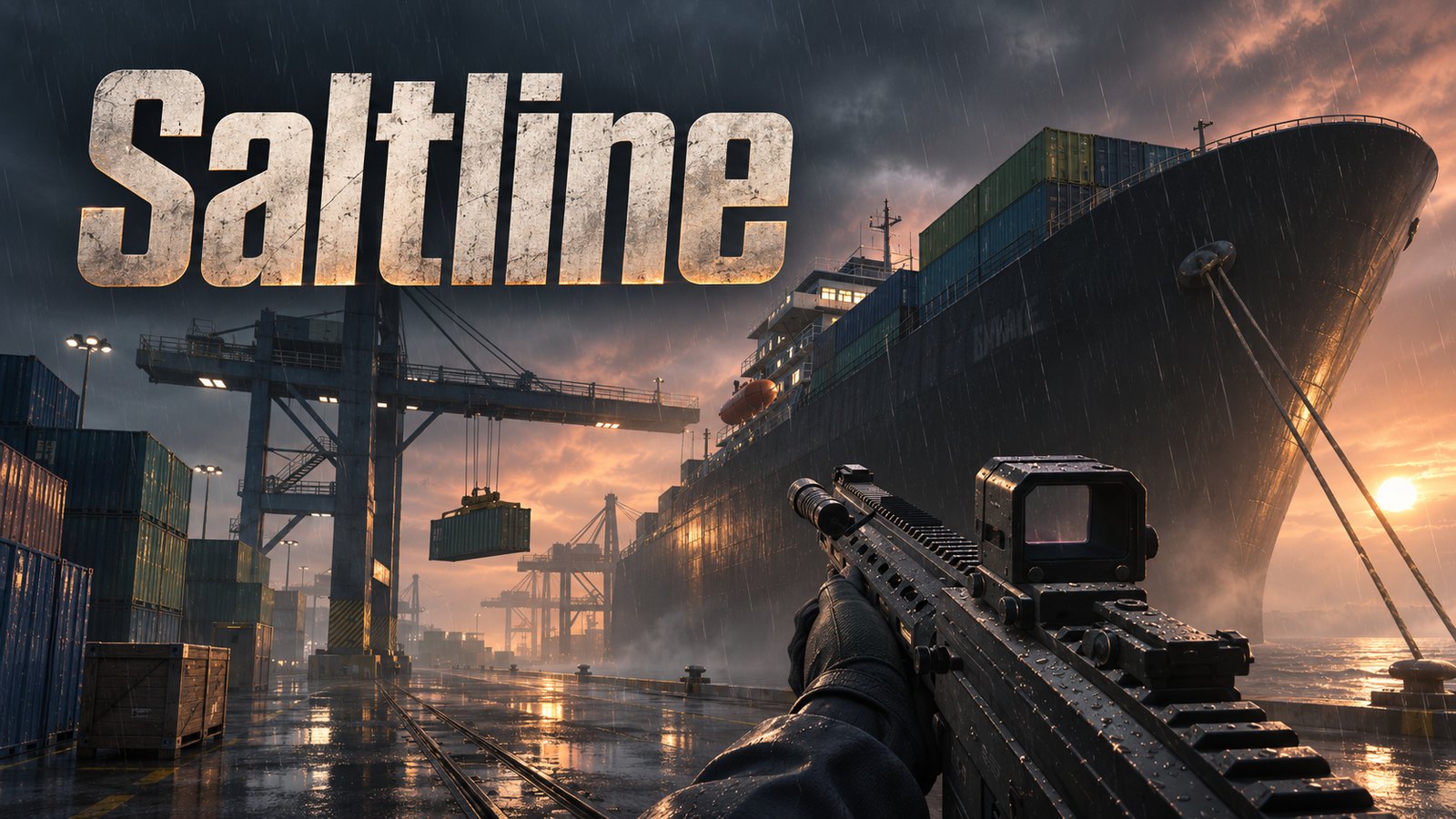
On 9 November 2026, the day Anthropic released Claude Fable 5.2, Anthropic engineer Felix Rieseberg posted a short clip of a first-person shooter set in a rain-soaked container port. The post said three things that made it spread: one prompt, no human feedback, about $550. Two days later it had been viewed nearly two million times.
The game is called Saltline, and you can play it in your browser right now.
What Saltline is
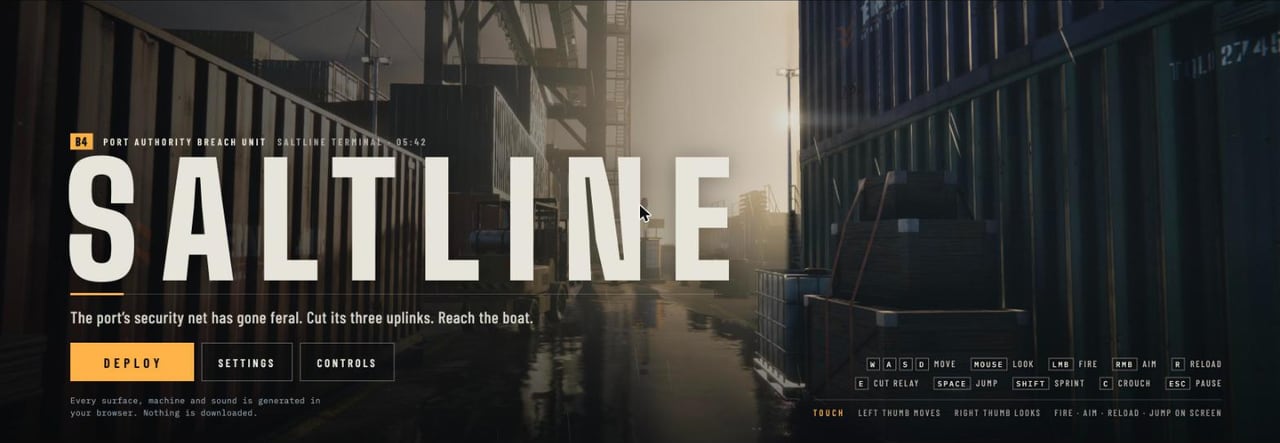
Saltline is one level, set at Saltline Terminal at 05:42 in the morning. You play a "Port Authority breach unit". The port's automated security has "gone feral", and your job is to cut its three uplink relays and reach the boat. Two kinds of robot come for you: four-legged hounds on the ground and drones in the air.
The controls are standard for a PC shooter:
- WASD to move, mouse to look, left click to fire, right click to aim
- R to reload, Shift to sprint, C to crouch, Space to jump
- E to cut a relay when you reach it
- On phones and tablets, the left thumb moves, the right thumb looks, and fire, aim, reload and jump are on-screen buttons
The heads-up display tracks your objective (relays 0/3), a compass with distance markers to each relay, and ammo for your rifle. If the browser can't capture the mouse, for example inside some embedded views, the game falls back to "move the mouse to the screen edge to keep turning".
Most players finish in a few minutes. That's by design: the prompt asked for a deliberately small scope.
How it was made
Felix's post gives the numbers:
- One prompt, no human feedback. He wanted to test Fable 5.2's quality on a single request and let the model work without stepping in.
- Everything from scratch. In his words, the "models, sounds, textures" were all generated. The title screen repeats the claim: every surface, machine and sound is generated in your browser, and nothing is downloaded.
- About 8 hours of running time.
- About 2.7 million output tokens and 445 million input tokens, "heavily cached".
- About $550 at API pricing.
The token split tells you how the work happened. Output tokens are the code and text the model wrote. Input tokens are everything it read, again and again: its own files, tool results, test output. An agent that works for 8 hours re-reads its project hundreds of times, and prompt caching makes that cheap. Fable 5.2 charges $0.20 per million tokens for cache reads, so even if all 445 million input tokens had been cache hits they would cost about $89. The 2.7 million output tokens at $40 per million are about $108. The rest of the $550 is the input that wasn't cached ($8 per million) and the cost of writing to the cache ($10 per million).
Is it really "one-shot"?
Yes and no, and the distinction matters if you want to reproduce it.
It is one-shot in the sense that a human typed one request and didn't correct the model along the way. It is not one-shot in the sense of the model writing a game in a single reply. A 445-million-token input total is the signature of a long agent loop: plan, write code, run it, look at the result, fix, repeat, for hours. Several commenters made this point when the post went viral, and they're right. "One prompt, eight hours of autonomous work" is the accurate description.
That isn't a weakness. It is what Fable 5.2 is built for. Anthropic's own launch material positions it for "the most ambitious, open-ended technical work" and long-horizon agent runs, and recommends the cheaper Opus 5.5 for most everyday coding.
Is it good?
As a game, it's a polished vertical slice. The lighting at dawn, the wet ground, the stacked containers and the gantry cranes look far beyond what anyone expected from code-generated assets a year ago. The weapon has a proper sight and reload animation, and the HUD is clean.
As a shooter, it's thin. There is one level, two enemy types and no human enemies. Some players report stutters or a frozen tab on weaker machines; the Settings screen lets you lower the quality, and that helps.
The fair comparison is not a commercial FPS. It's what one person could make in eight hours, and on that scale it's remarkable.
The other two games in the set
Felix published Saltline with two more Fable 5.2 games, both described as first drafts with no human feedback. In his launch-day thread he said he was most impressed by the shooter, but the other two are worth playing:
- The Clockmaker's Heart: restore a giant brass automaton by solving gear puzzles in each of its seven organs.
- Tidewright: sail a small boat through a storm and relight the lighthouses of the Thrumming Isles.
All three are listed in our roundup of games made with Claude Fable 5.2.
How to try something similar
If you want to make your own one-prompt game, three things from Saltline carry over:
- Ask for a small scope and high detail. One level, one objective, done well.
- Let it run. Use a harness that can work for hours, such as Claude Code, at
higheffort or above. - Budget for it. Even with heavy caching, a long run on Fable 5.2 costs hundreds of dollars at API prices. On a Claude subscription, Fable usage counts toward your plan's limits instead.
Our Three.js game guide for Claude Fable 5.2 has a full prompt you can start from.